
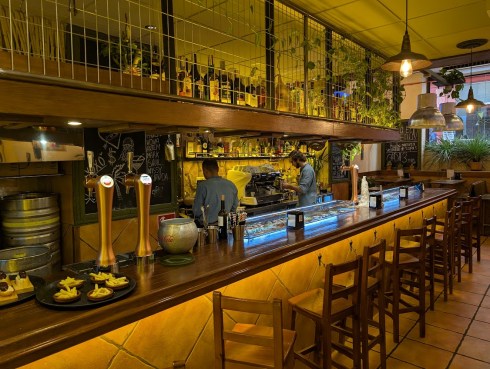
Tapas is new to us. We walk past all kinds of tapas restaurants on our perambulations around the city. Some are sidewalk window service, usually surrounded by a group of men talking, smoking and eating. And others are white-tableclothed fine dining.
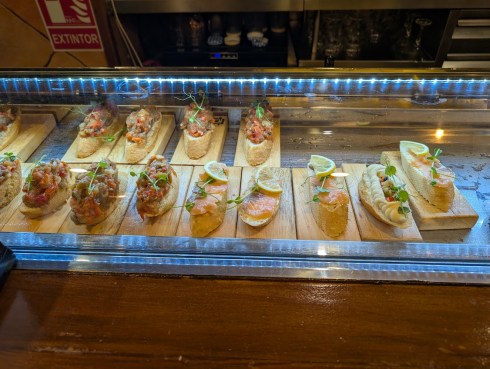
Characteristic of all that we saw, was a case with cold tapas displayed on entering. Then you usually pass by a bar with high stools and a few tables. Some open to a larger dining room.
We had no idea how this all worked. Did you stand at the counter, make your choice, carry it to a free table? Was there a menu? Was there a waiter? With limited Spanish the process was elusive. Best to sally forth.
We enter past the display case, and the bar, to the dining room and choose a table. Aha…there is a waiter. He does bring menus. There are no photos or descriptions of tapas on the menu which is puzzling. We order. He looks surprised. In a bit he appears with a small board and a small bowl. Each board has a thick slice of French bread topped with sauteed mushrooms. Each bowl holds several roasted peppers. So, this is how it works. (We must have ordered tapas.) Then he brings a full meal. Now we are surprised.
It wasn’t until we pay the check and leave that we see the little sign on the wall, in five languages. Here are the instructions on how a tapas restaurant works. You sit and order a drink, traditionally a beer. You don’t need a menu. The waiter passes by every few minutes with a tray offering one type of tapas. You can choose it or pass and wait for the next round. The bill is calculated by the empty serving boards or dishes or toothpick skewers left on the table.
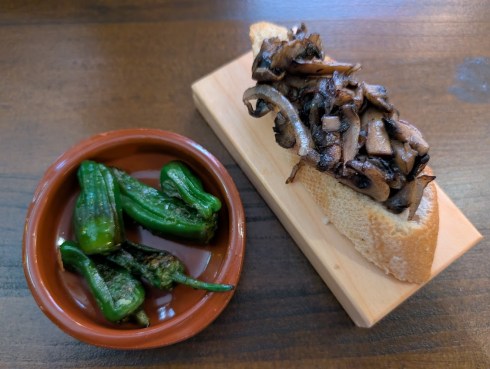
It is now we realize the only tapas we have eaten are the two the waiter gave us to show us what a tapas is. He gave us a really big smile on our way out.
 MedFlies