
When Rome ruled Lecce the city was wealthy, a “sister city” of Rome. Her wealth came in great part from olives. Lamp grade olive oil was prized throughout all of the Roman Empire. The oil burned without smoke and without odor, a marked improvement over other sources of light. At its height in the first and second centuries, more than 8000 Apulian citizens were involved in the production and processing of olive oil in Lecce, a large percentage of the population of the region.
And with this great wealth came an explosion of culture. In the Roman amphitheater it was the gladiators and daily executions. But very close to the Amphitheater was the Roman Theater playing an essential role of the society of Lecce.

Roman theater unlike Greek “theater in the round” from which it evolved, has a stage with a proscenium arch, three entrances and a semi-circular apron. The seats (for an audience of up to 6000) were in banks to the top of the three-story theater. Today only a remnant of this theater “house” remains.
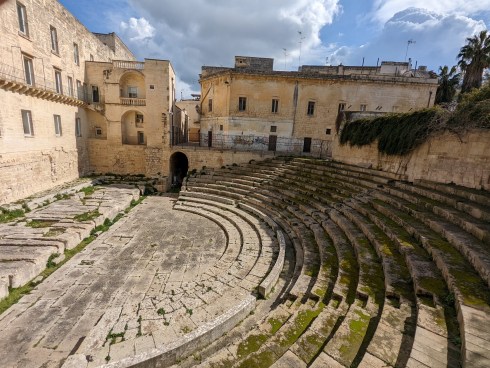
The actors were distant from the majority of the audience. They used large symbolic gestures of the body, arms and hands and signatory masks to express codified emotions to the audience. The masks had built in voice amplifiers to reach the viewers in the back of the house.


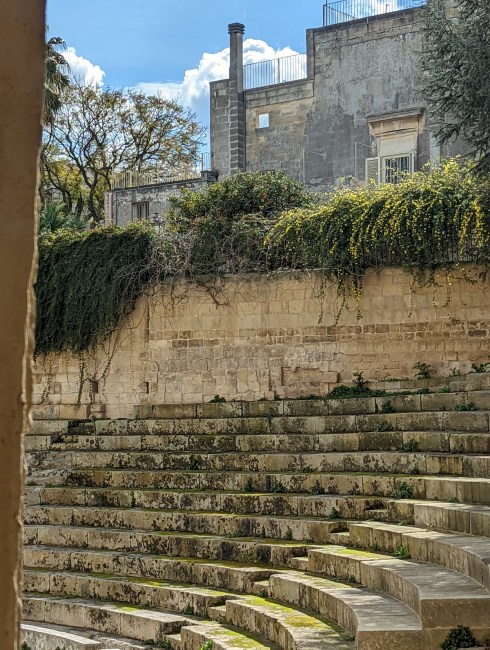
At its pinnacle thousands and thousands of Lecce citizens watched traditional tragedies and comedies here. Today the theater ruins sit quietly in the sun.
 MedFlies